



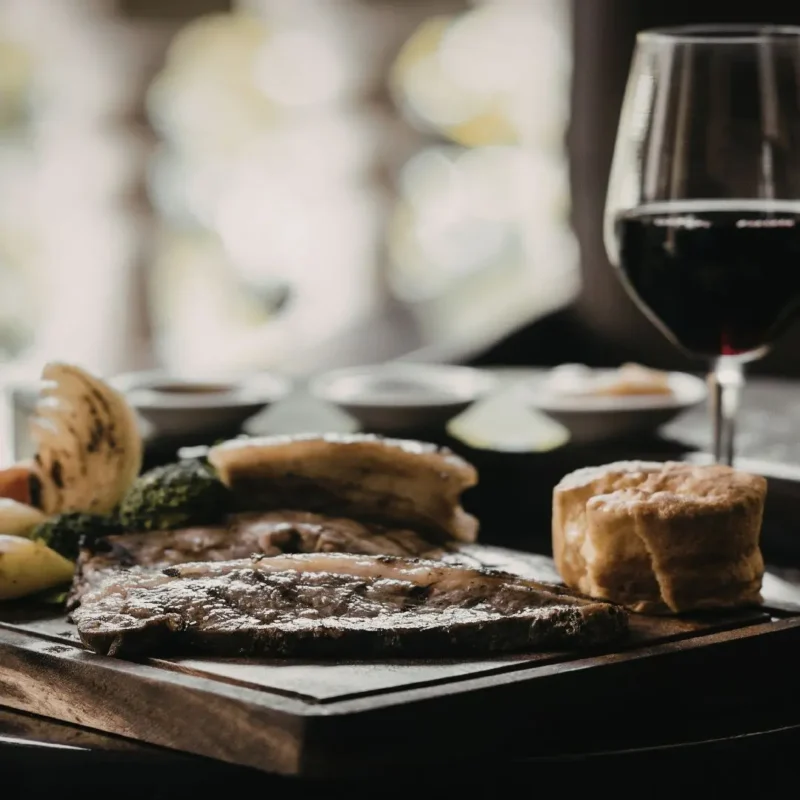
Few experiences in Argentina’s wine country are as complete as sitting down to a gourmet lunch inside a working winery. You’re not just eating — you’re surrounded by barrel rooms that still carry the scent of oak, vineyards that stretch toward the Andes, and a glass in front of you that tells the story of everything you just saw on the tour. The pace slows down, the conversation opens up, and somewhere between the first and second pour, Mendoza starts to feel less like a destination and more like a state of mind.
But “lunch at a winery in Mendoza” is not one single thing. The region spans several distinct wine-growing areas, each with its own altitude, microclimate, grape profile, and culinary character. What you’ll eat and drink in Luján de Cuyo is not what you’ll find in the Uco Valley, and both are worlds apart from what San Rafael has to offer. This guide breaks it all down so you can match the experience to exactly what you’re looking for — whether that’s a relaxed afternoon close to the city or a full-day journey into high-altitude wine country.
If you would rather have the day organised for you, we run wine tours with lunch included, with the wineries confirmed and the table booked before you arrive.
What to expect from a winery lunch in Mendoza
Before diving into regions, it helps to understand what this type of experience actually involves. Most winery lunches in Mendoza follow a similar arc: you arrive mid-morning, take a guided tour of the production facilities and vineyards, participate in a structured tasting of two to four wines, and then sit down to a multi-course meal where each dish is paired with a glass from the winery’s portfolio.
download the best winery map
Find the exact location of each winery in Mendoza!
Download the Map Now!

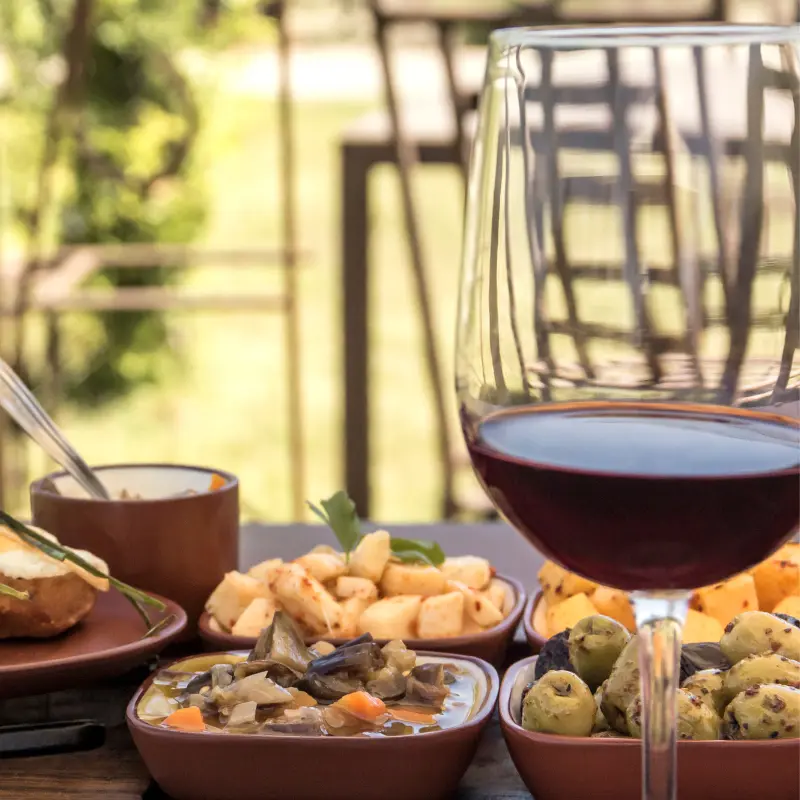
The meal itself typically lasts between 90 minutes and two hours. You can expect regional ingredients — olive oil from Maipú, grass-fed beef from local producers, fresh vegetables from Andean-foothill farms — prepared with a level of care that reflects the winery’s investment in the full guest experience. Some bodegas offer à la carte menus; others work with a set tasting menu designed specifically to showcase their flagship varietals.
A few practical points worth knowing before you book:
- Duration: A winery tour with lunch typically runs 7 to 8 hours for a two-winery itinerary and 8 to 9 hours when three wineries are included — door to door from the city of Mendoza. Uco Valley tours add 30 to 45 minutes of extra driving each way given the distance from the city.
- Dietary needs: Most quality wineries accommodate vegetarian, vegan, and celiac requirements if notified in advance.
- Dress code: Smart casual is the standard. Comfortable shoes are strongly recommended — cobblestone barrel rooms and vineyard paths are the norm.
- Alcohol: Lunch pairings are included in the tour cost. Additional bottles can usually be purchased.
- Best months: October through April is peak season, when vineyards are green and the light on the Andes is extraordinary. That said, winter visits (June–August) have their own appeal — smaller crowds, harvest off-season atmosphere, and rich stews on the menu.
Discover Mendoza’s
best wine experiences
From boutique wineries to award-winning lunches, find the perfect tour for you
Explore all our wine tours!
MENDOZA WINERY LUNCH TOURSIf lunch isn’t the right fit for your schedule, Mendoza’s winery dinner tours offer the same vineyard setting and pairing experience under a different light, a slower pace, candlelit barrel rooms, and menus built around the evening’s cooler temperatures.
Lunch is only one of the reasons to book a winery. If you are still deciding which estates to build the day around, our guide to the wineries in Mendoza open to visitors lists them by region, with what each one is known for.
Luján de Cuyo — the most celebrated wineries for lunch
Luján de Cuyo sits about 25 kilometers south of the city of Mendoza, at elevations between 900 and 1,100 meters. This is Malbec’s historic home in Argentina — the subregion that first established the variety’s reputation internationally. The wineries here tend to blend tradition with a serious commitment to the table, and several of them have built dedicated restaurant spaces that are among the best in the province.
Budeguer is typically the starting point on any serious winery lunch itinerary in Luján. A family-run project with a strong focus on single-vineyard Malbec, the property offers an intimate setting where the scale of the operation means you’re genuinely interacting with the people who make the wine.
Pulmary brings a more architectural approach — the building itself is part of the experience — paired with a menu that leans heavily on local produce and careful wine selection from their premium range.
Terraza de los Andes and Lamadrid are two properties worth considering for travelers who want a slightly more expansive tasting before lunch. Both have well-structured tour programs that move efficiently through the production areas before transitioning to the dining room.
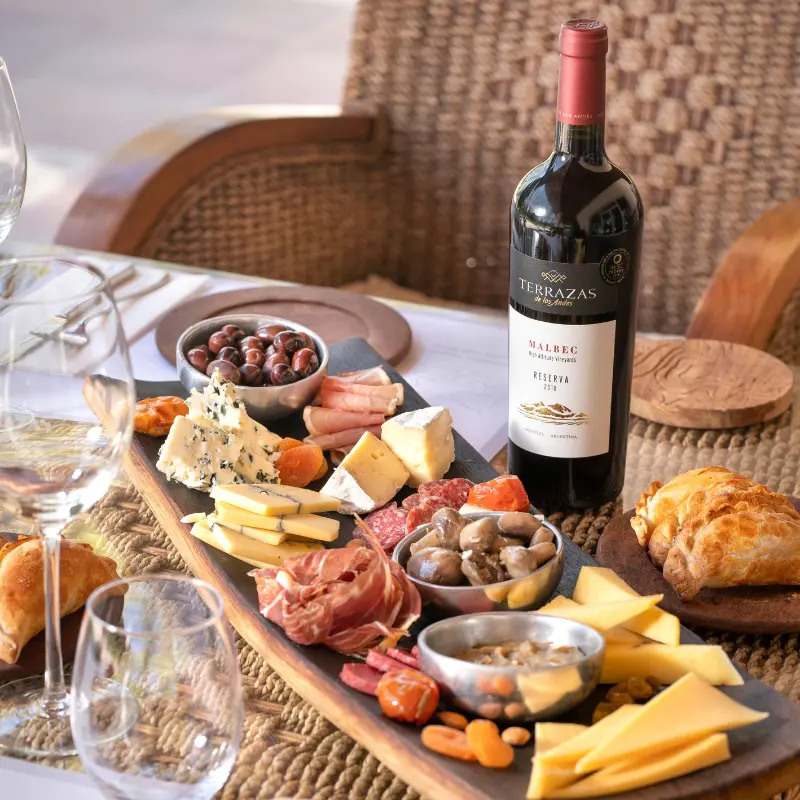
Regional flavors and varietals paired in an elegant winery setting.
For those who want something that combines history with gastronomy, Alta Vista and Lagarde are among the oldest estates in the region. Lagarde in particular operates out of a 19th-century finca and has a well-regarded restaurant where the cellar-to-table concept feels genuinely earned rather than just marketed.
Other notable options in Luján include Foster Lorca, Finca Bandini, Norton, Vistalba, Kaiken, Benegas, Matervini, and Clos de Chacras — the density of quality options in this subregion is one of the reasons it remains the most visited wine area in Argentina.
If you’d rather not choose between regions, it’s possible to combine two wine areas in a single day. A Luján + Maipú 3-winery lunch tour lets you experience both subregions’ distinct styles and terroirs without sacrificing the leisurely pace that makes a winery lunch worthwhile.

Maipú — accessible options close to the city
If your time in Mendoza is limited or you’re looking for a more relaxed, accessible half-to-full-day format, Maipú is the answer. Located just 15 kilometers from downtown, the department is easy to reach and home to a cluster of well-organized wineries that have built efficient hospitality programs for visiting travelers.
The wineries here tend to be larger operations, which means more infrastructure around the dining experience — dedicated restaurant spaces, trained service staff, and menus that have been refined over years of welcoming international guests.
Santa Julia (operated by the Zuccardi family) is one of the most visitor-friendly properties in the entire Mendoza wine circuit. The approach to sustainability and local ingredients is visible throughout the lunch service. Carinae offers a more intimate French-Argentine hybrid experience — a small Bordeaux-trained producer who brings serious technical knowledge to the tasting.
Tempus Alba, Trivento, and Trapiche round out the main options in Maipú. Trapiche in particular — one of Argentina’s most internationally recognized producers — operates a substantial cellar facility that is worth visiting just for the architecture and history, with lunch in a setting that matches the scale of the brand.

The Maipú circuit pairs naturally with a visit to one of the region’s olive oil producers, and several of SAK Wine Travel’s tours combine both into a single day that gives a fuller picture of Mendoza’s agricultural identity.
Valle de Uco — the most exclusive winery lunch experience
The Uco Valley is where Mendoza’s winery lunch experience reaches its ceiling. Located 80 kilometers south of the city, at elevations between 1,000 and 1,500 meters, this is the region that has drawn the most significant international investment over the past two decades — and it shows. The wineries here are often architectural landmarks as much as production facilities, the wines command some of Argentina’s highest prices, and the lunch programs have been designed to match.
The drive itself is part of the experience: you pass through fruit orchards and open desert before the valley opens up and the snow-capped peaks of the Andes appear at a scale that genuinely takes you by surprise.
Andeluna, Domaine Bousquet, Masi, and Salentein are among the most established Uco properties for touring and dining. Salentein’s chapel-style bodega and its restaurant — set inside a property that looks more like a European estate than a South American winery — is frequently cited as one of the top winery lunch experiences in Argentina.
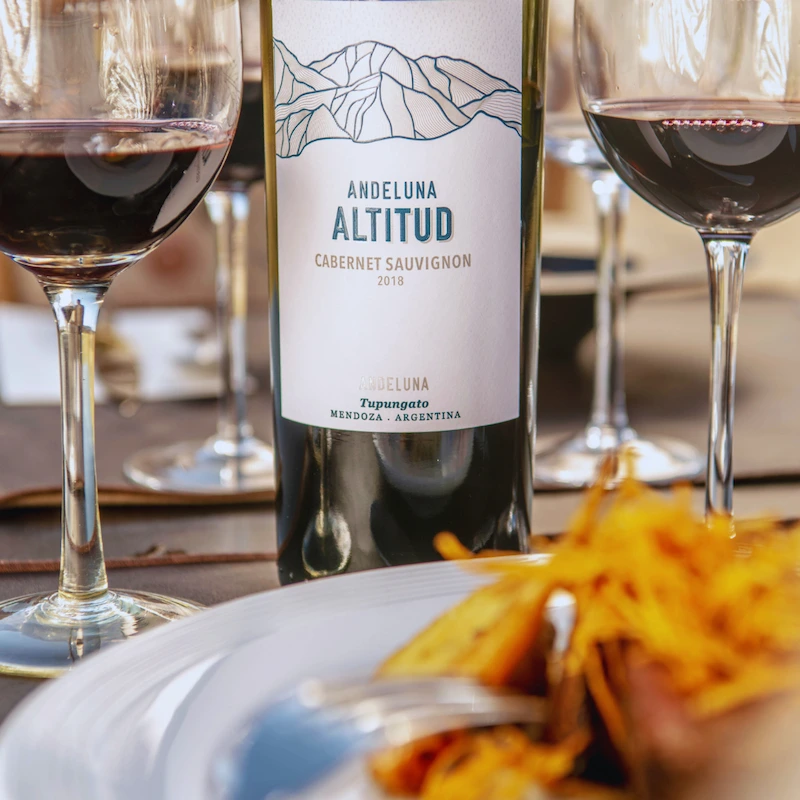
Finca Adelma, Diamandes, Piedra Negra, Monteviejo, Flecha de los Andes, and Atamisque each bring their own angle to the high-altitude tasting experience. The common thread is quality: this is a region that has bet heavily on premium positioning, and the food programs have followed.
If you’re specifically interested in the Valle de Uco and want to go deeper into the wineries, the terroir, and what makes this subregion unique, read our complete guide to winery lunches in the Uco Valley →
The trade-off with Uco is logistics. The distance from the city means a round trip takes 9 to 10 hours — which is not a problem on a dedicated day but rules out combining it casually with other city-based activities. Booking through a local operator with private transfers is strongly recommended, particularly for the mountain roads in winter.

San Rafael — for travelers extending the trip south
San Rafael sits roughly 230 kilometers south of Mendoza city, in a wine subregion that most international visitors never reach — which is precisely what makes it interesting. The area has its own wine identity, built primarily around Malbec, Cabernet Sauvignon, and Chenin Blanc, and a gastronomy scene that benefits from the surrounding ranching and agricultural land.
The wineries here operate at a different pace than those in Luján or the Uco Valley. Fewer international tour groups means a more personal interaction with winemakers and staff, and the lunch experience tends to feel less produced and more genuinely local.
San Rafael also serves as a base for exploring the nearby Atuel Canyon and the thermal baths at Cacheuta — so if your itinerary includes more than just wine, the south offers a natural way to combine everything. This is a two-day trip minimum from the city of Mendoza; trying to do it as a day trip doesn’t do justice to either the wine or the landscape.
How much does a winery lunch in Mendoza cost?
Prices for winery lunch experiences in Mendoza vary based on region, number of wineries visited, and the type of service — private, semi-private, or group. The table below reflects current 2026/2027 pricing from SAK Wine Travel, expressed in USD per person, for their most popular winery lunch formats.
| Experience level | Region | Duration | Price range per person (2 pax) |
|---|---|---|---|
| Standard | Luján de Cuyo / Maipú | 7–8h | USD 279 – 330 |
| Standard | Valle de Uco | 7–9h | USD 320 – 384 |
| Premium | Luján de Cuyo / Maipú | 7–9h | USD 339 – 393 |
| Premium | Valle de Uco | 7–9h | USD 360 – 456 |
| Premium+ | Luján de Cuyo / Maipú | 8–9h | USD 380 – 462 |
| Premium+ | Valle de Uco | 8–9h | USD 402 – 560 |
Prices are per person in USD, based on 2 passengers on a private tour. Ranges reflect 2-winery (lower end) to 3-winery (higher end) itineraries within each category. All prices include private transfer, high-end vehicle, bilingual guide, snack, and gourmet paired lunch. Rates valid through May 2027.

The difference between categories is not just about price — it reflects the depth of the experience. Standard tours are designed for travelers who are new to wine culture and want a clear, accessible introduction to Mendoza’s wineries. Premium tours go deeper: better-curated estates, more technically engaged tasting sessions, and restaurants that have been built specifically around the wine. Premium+ is for travelers who want the exceptional end of the market — estates with international recognition, exclusive access arrangements, and lunch menus that match the quality of the wines being poured.
Group size also plays a significant role in the final cost. Per-person rates drop considerably from groups of 3 onwards, making this type of experience more accessible for families or small travel groups than the 2-person base rate suggests.
How to book a winery lunch tour in Mendoza — and what’s included with SAK
The practical question most travelers have once they decide they want this type of experience is: do I book directly with the winery, or do I work with a local operator?
Direct bookings at wineries are possible and work well for travelers who want to arrive independently, have their own transportation, and prefer to manage each element separately. The limitation is that most top-tier winery lunch programs require advance booking of 48 to 72 hours, some require a minimum number of diners, and language barriers can complicate the process for non-Spanish speakers.
Working with a local operator like SAK Wine Travel means the logistics are handled — private transfer in a high-end vehicle, bilingual guide throughout the day, winery reservations confirmed in advance, and dietary requirements communicated before arrival. As a local operator with established relationships across all of Mendoza’s wine regions, SAK can access wineries and experiences that are not always available to independent travelers, particularly at the premium and private level.
Every SAK winery lunch tour includes:
- Private round-trip transfer from your hotel in Mendoza city
- High-end vehicle with bilingual guide
- Handmade snack and mineral water during transit
- Guided visits and tastings at selected wineries
- Gourmet paired lunch at the final winery of the day
- Personal accident insurance

Tours operate daily, with departures every day of the week. Semi-private formats (maximum 8 guests) are available for travelers who want a dedicated service at a more accessible price point while still maintaining the quality and personal attention of a small-group experience.
Browse SAK’s winery lunch tours and check availability →
If you’re combining a winery lunch with a dinner experience at a different property, SAK also operates winery dinner tours in Mendoza, a tapas-style sunset dinner format that works particularly well as a companion to a lunch-focused day in a different region.
Lunch with children is its own question, and not every estate is set up for it. Our guide to wineries that genuinely welcome children covers the ones with gardens, kids’ menus and something for them to do while the adults taste.
Frequently asked questions
Do I need to speak Spanish to do a winery lunch tour in Mendoza? No. SAK’s tours are conducted in English (and Portuguese), and the bilingual guides are with you throughout — at the winery, during the tasting, and at the table. If you book independently at a winery, English-speaking staff availability varies.
Is lunch always included in a winery tour? Not automatically. Many wineries offer separate tasting and dining programs. When you book a lunch-specific tour, the meal and wine pairing are included and pre-arranged.
Can I visit more than one region in a single day? Yes, for adjacent regions. SAK offers combined itineraries covering Luján + Maipú or Luján + northern Uco Valley in a single day. Combining Luján or Maipú with southern Uco or San Rafael in one day is not recommended — the distances make for a rushed experience.
Are the prices fixed or can I customize the experience? SAK’s Private Mixed and Private Exclusive formats are fully customizable in terms of winery selection, itinerary timing, and special requests. Pricing adjusts based on configuration and group size.
What’s the minimum group size? Semi-private tours require a minimum of 2 passengers and run daily. Private tours are bookable for any group size starting from 1 passenger.
Is wine tourism in Mendoza good in winter? Yes. June through August brings cooler temperatures and smaller crowds. Vineyards are dormant but barrel rooms, architecture, and mountain views are still the main draw — and winter menus at winery restaurants tend to be particularly good.
Paula is a travel communications specialist with solid expertise in wine tourism and adventure travel in her native Mendoza. She combines a background in audience analysis with a deep understanding of today’s travelers to craft effective, user-centered, and sustainable content strategies. Her approach blends creativity, data, and a strong commitment to the responsible development of tourism in Argentina.