


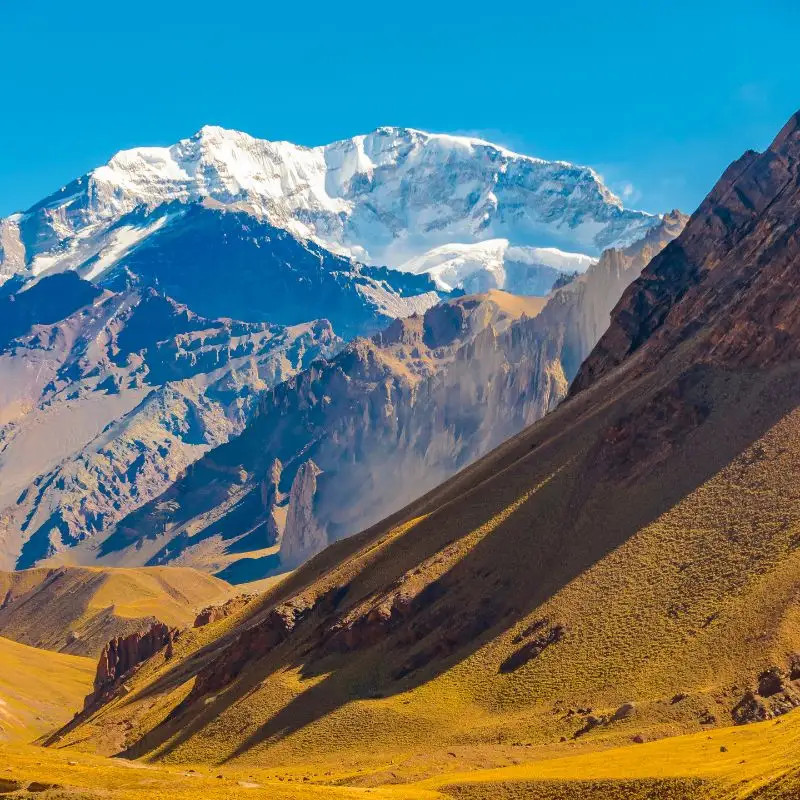
The honest answer is that “climbing Aconcagua” describes six different trips, and they are not equally hard. One of them is a day walk. One of them takes three weeks and asks for prior experience above 4,500 metres. Almost everything written about the difficulty of this mountain answers only for the last one, because almost everyone writing about it only sells that.
So here is the graded version: what each level of the mountain actually demands, how high it takes you, and where Aconcagua sits against the peaks people compare it to.
The six levels of Aconcagua, graded
| What you are doing | Type | How long | Level | Summit attempt |
|---|---|---|---|---|
| Viewpoint from the road | Excursion | 1 day | Easy | No |
| Confluencia base camp hike | Day trek | 1 day | Easy / Moderate | No |
| Plaza Francia and the South Wall | Trekking | 3 days | Moderate | No |
| Plaza Francia + Plaza de Mulas | Trekking | 7 days | Intermediate | No — 5,000 m maximum |
| Summit by the Normal Route | Expedition | 21 days | Advanced | Yes |
| Summit by the 360 circuit | Expedition | By arrangement | Advanced | Yes |
The jump that matters is between the seven-day trek and the summit expedition. Everything up to 5,000 metres is a question of fitness and patience. Above that it becomes a question of how your body handles altitude, and that is not something you can train into certainty.
The perfect checklist for a Mendoza trip
Plan your trip, we care about you!
Download this awesome checklist!
DOWNLOAD NOW
What is actually hard about it
Not the climbing. The Normal Route is not technically difficult: you do not need ropes, ice axes or crevasse training. That is the sentence that surprises people, and it is why Aconcagua attracts climbers with no climbing background — it is the highest mountain outside Asia and you walk up it.
What is hard is the altitude and the time you spend in it. At 6,962 metres the air holds under half the oxygen it does at sea level, and no amount of experience lower down fully prepares you for how your particular body responds above 6,000 metres. Add three weeks of cold-weather camping, a loaded pack, wind, and the fact that summit day is long and comes at the end, and the difficulty is cumulative rather than technical.
- Altitude, not gradient. The route is a long walk on scree and snow slopes, not a face.
- Duration, not intensity. Twenty-one days of camping and carrying is a different demand from one hard day.
- Cold and wind. The upper mountain is exposed, and the weather turns the schedule, not the other way round.
- Judgement. The commonest reason people do not summit is that they went too fast too early, and the mountain does not give that back.
Aconcagua compared to the mountains people ask about
These are the four comparisons that come up in every conversation, put next to each other by the one figure that is genuinely comparable: how high they are.
| Mountain | Height | Where |
|---|---|---|
| Aconcagua | 6,962 m | Andes, Argentina — highest in the Americas and the highest outside Asia |
| Denali | 6,190 m | Alaska Range, United States — highest in North America |
| Kilimanjaro | 5,895 m | Tanzania — highest in Africa |
| Elbrus | 5,642 m | Caucasus, Russia — highest in Europe |
| Mont Blanc | 4,807 m | Alps, on the French–Italian border |
Read against that table, the usual questions answer themselves. Aconcagua is more than a kilometre higher than Kilimanjaro, and about 770 metres higher than Denali. It is also, unlike Denali, approached from a road rather than a glacier flight, and unlike Mont Blanc it does not ask for rope work on the standard route. The difficulty is concentrated almost entirely in the altitude and the length of the trip.
Which is why comparing summit difficulty across mountains is mostly unhelpful: the honest comparison is between how each one punishes a different weakness. Aconcagua punishes impatience and poor acclimatisation. It does not punish a lack of technical skill, because it does not ask for any.
What we ask of you, level by level
For a summit expedition
These are our recommendations, and we would rather have the conversation before you book than watch you turn back:
- Prior high-altitude experience above 4,500 metres.
- Strong cardiovascular fitness — ideally 5 to 6 days a week of sustained aerobic training for three months or more before departure.
- Experience of multi-day trekking with a loaded pack.
- Familiarity with cold-weather camping and layering systems.
For the three-day and seven-day treks
Moderate fitness and some hiking experience are enough. The seven-day trek tops out around 5,000 metres at Cerro Bonete, which is high but is not a summit attempt on Aconcagua itself. Both are in our Aconcagua programmes.
For the day options
No special preparation beyond general good health. The viewpoint is a drive with a short walk. The Confluencia base camp hike climbs from 2,800 to 3,400 metres in about four hours of walking and is comfortably within reach of anyone who walks regularly — and it is the closest most people will ever stand to the summit of the Americas.
If you are not sure which level fits you, tell us what you have done before and we will tell you honestly. That conversation costs nothing and saves a great deal.
The two things that decide the outcome
Acclimatisation. The single most useful thing you can do before a summit attempt is arrive already used to altitude. In Mendoza that means the Cordón del Plata: from Vallecitos, 90 kilometres from the city, you climb Cerro Arenales at 3,400 metres and Cerro Lomas Blancas at 3,700 in a day, from USD 116. It sits with our trekking day trips and it is the cheapest insurance available against losing an expensive expedition to altitude.
The window. The park issues trekking and climbing permits from mid-November to late February and stops issuing new ones at the end of February. Within those fifteen weeks the conditions are not equal either — we take the season month by month in when to climb Aconcagua, and the approach itself, entrance by entrance, in how to get to Aconcagua from Mendoza.
Frequently asked questions
How hard is it to climb Aconcagua?
On the Normal Route it is a non-technical climb: no ropes, no ice axes, no crevasse training. The difficulty is altitude and duration. At 6,962 metres it is the highest peak outside Asia, the expedition runs about 21 days, and we recommend prior experience above 4,500 metres and three months of serious aerobic training before you come.
Can a beginner climb Aconcagua?
A beginner at technical climbing, yes — there is nothing technical to be a beginner at on the Normal Route. A beginner at altitude, no. The mountain does not ask for skills you do not have; it asks for a body that has been high before and a schedule you are willing to obey. If you have never been above 4,500 metres, do that first.
Is Aconcagua harder than Kilimanjaro?
It is higher by more than a kilometre — 6,962 metres against 5,895 — and the trip is far longer, around three weeks against roughly a week. Neither is technical on its standard route, so the difference is almost entirely altitude and duration. That makes Aconcagua the bigger undertaking by a clear margin, without making it a harder climb in the technical sense.
Is Aconcagua harder than Denali or Mont Blanc?
Aconcagua is higher than both: 6,962 metres against 6,190 for Denali and 4,807 for Mont Blanc. But they are hard in different ways — Denali is a cold, glaciated, self-supported mountain and Mont Blanc asks for rope work on its standard routes, while Aconcagua asks for neither. Comparing them on a single scale is not useful; comparing what each demands of you is.
Do you need oxygen on Aconcagua?
It is climbed without supplementary oxygen. That is exactly why acclimatisation carries so much weight on this mountain, and why the schedule is built around going high and sleeping low rather than around covering ground.
Do you need technical climbing skills?
Not for the Normal Route. You need to be comfortable walking long days on scree and snow with a pack, camping in the cold, and managing your own layers. What we look for is high-altitude experience and aerobic condition, not rope skills.
Is there an easier way to see Aconcagua?
Several, and they are the levels most people should be looking at. The viewpoint from the road is a full day from Mendoza from USD 118. The Confluencia base camp hike is a full day from USD 259 and takes you inside the park to 3,400 metres. Plaza Francia over three days reaches 4,100 metres with no summit attempt at all.
Pick the level, not the mountain
The mistake is treating Aconcagua as a single yes-or-no question. It is a ladder, and most people who ask us how hard it is turn out to want a rung well below the top — which is a good outcome, not a compromise. The 360 circuit and the Normal Route are there for the people who want the summit, and the day and multi-day treks are there for everyone who wants the mountain without the three weeks. Both live in our high mountain programmes.
Grading, durations and physical requirements are the ones we publish for our own programmes. Prices are current starting rates from our catalogue, per person, and do not include the park permit, whose fees the province of Mendoza sets each season. We do not publish summit success rates, because any figure that is not tied to a specific operator, route and season is meaningless.

Pingback: How to Get to Aconcagua from Mendoza (2026 Access Guide)
Pingback: High Mountains of Mendoza: A Local’s Guide to the Andes