


The best time to visit Mendoza depends on one thing: what you came for. The short answer is March or April if you are here for the wine — harvest runs from late February to early April and the wineries are actually working. Come between December and February if you want the high Andes, the rivers and Aconcagua, because that is the only window when the mountain is open. Come between June and September for snow. Everything in between is a trade-off between crowds, price and what is genuinely open.
That trade-off is what this guide is about. Below you will find Mendoza month by month, the three seasonal windows that actually constrain a trip, and what each season costs on our Mendoza packages and day tours — real prices from our own catalogue, not estimates. We are a receptive agency based in Mendoza and we run these tours ourselves, so the dates below are the ones we work with.
Best Time to Visit Mendoza Based on Your Travel Style
There’s no single answer to the best time to visit Mendoza—it depends on your travel goals. Mendoza isn’t a one-dimensional destination. Yes, it’s about wine. But it’s also about mountains, gastronomy, culture, adventure, relaxation, and nature. To help you decide more clearly, here’s what to expect in each season based on your interests:
- Wine tourism: Autumn (March to May) and spring (September to November) are ideal for winery visits, whether by car, bike, or on foot. Harvest happens in March, with mild weather and colorful vineyards. December, January, and February are also popular with international travelers from the Northern Hemisphere who come to enjoy wine tours during the Southern Hemisphere’s summer. If wine is your main focus, plan your Valle de Uco visit around these seasons for the best combination of weather and harvest activity.
- Mountain trips: The best time is summer (December to March) or late spring. High mountain routes are open, roads are safe, and visibility is excellent.
- Adventure travel: Rafting, trekking, horseback riding, or mountain biking can be enjoyed year-round, but summer and spring offer the best conditions. In winter, some activities continue with seasonal adaptations (like snowshoeing instead of hiking).
- Snow trips: June to September, mainly in Vallecitos or Penitentes (when ski resorts are open). Mount Aconcagua is also snow-covered and breathtaking, but park access is restricted in winter due to safety regulations.
The perfect checklist for a Mendoza trip
Plan your trip, we care about you!
Download this awesome checklist!

Climate Comparison by Season
| Season | Max Temp | Min Temp | Rainfall | Wind (Zonda included) |
|---|---|---|---|---|
| Summer | 86–95°F | 63–72°F | Moderate | Present in December |
| Autumn | 64–82°F | 45–59°F | Low | Common in May |
| Winter | 54–64°F | 32–41°F | Very low | Strongest in August |
| Spring | 68–86°F | 50–63°F | Low | Intense in October |
Mendoza Month by Month: Weather, Wine and What Is Actually Open
Most seasonal guides stop at four seasons. In Mendoza that is not enough, because a vineyard in March and a vineyard in May are two different places, and the mountain is open in December and closed in July. Here is the whole year, one row at a time.
| Month | Avg high / low | In the vineyards | In the mountains | Crowds & prices |
|---|---|---|---|---|
| January | 87 / 65 °F (30.7 / 18.3 °C) | Grapes ripening; wineries busy with visitors, not work | Peak Andes season. Best summit window on Aconcagua | Highest demand and prices |
| February | 85 / 62 °F (29.2 / 16.9 °C) | Early harvest begins in the warmer zones | High mountain fully open; Aconcagua permits close at month’s end | High, and Vendimia sells out |
| March | 80 / 59 °F (26.5 / 15.0 °C) | Full harvest across Luján de Cuyo, Maipú and Uco Valley | Roads open, cooler and clearer than January | High. Book wineries weeks ahead |
| April | 72 / 52 °F (22.0 / 10.9 °C) | Late harvest in Uco Valley; vine leaves turning red | Excellent visibility, first cold nights | Shoulder — the best value of the wine season |
| May | 64 / 45 °F (18.0 / 7.2 °C) | Vineyards dormant and golden; quiet tasting rooms | First snowfalls around Uspallata and Potrerillos | Low season |
| June | 60 / 39 °F (15.3 / 3.9 °C) | Pruning season; longest, calmest tastings of the year | Ski season opens at Las Leñas and Penitentes | Low, rising late in the month |
| July | 58 / 37 °F (14.7 / 2.9 °C) | Bare vines, snow-lined rows, hearty winery lunches | Peak snow. Argentine school holidays fill the resorts | High season — book early |
| August | 64 / 41 °F (17.6 / 4.9 °C) | Still dormant; strongest Zonda wind of the year | Snow still good, fewer people than July | Medium |
| September | 69 / 46 °F (20.5 / 7.7 °C) | Budbreak; almond trees in blossom | Snow melting, high routes reopening gradually | Low — a genuinely underrated month |
| October | 75 / 52 °F (24.0 / 11.2 °C) | Green shoots, ideal weather for bike tours | Routes reopening; muddy trails and gusty afternoons | Shoulder |
| November | 81 / 58 °F (27.3 / 14.4 °C) | Flowering; long, warm evenings on winery terraces | Aconcagua climbing season opens mid-month | Shoulder — very good value |
| December | 86 / 63 °F (30.0 / 17.1 °C) | Grapes swelling; open-air dinners and tastings | Rafting and kayaking at their best; all passes open | High from mid-month |
Two patterns are worth pulling out of that table. April and November are the two months where good weather and low demand overlap — if your dates are flexible, those are the weeks to aim for. And July is high season even though it is the coldest month of the year, because that is when Argentine families come for the snow.
Mendoza in Spring: Warm Air and Blooming Vineyards
Spring is a vibrant season. Irrigation ditches flow again, almond trees blossom, and vines sprout. Mendoza turns green, with ideal temperatures for walking, biking, or having lunch outdoors. You’ll see life in every park and plaza, and snow begins to melt in the mountains.
Recommended activities: a picnic in winery gardens, a regional cooking class, or a bike wine tour through vineyards.
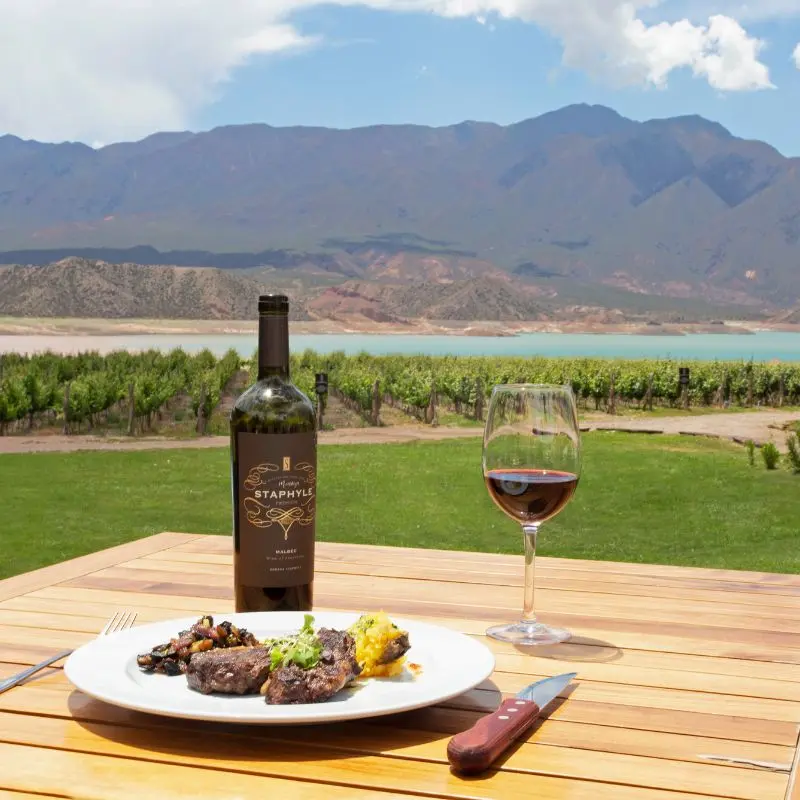
Mendoza in Summer: Intense Sun, Ripe Grapes, and Outdoor Thrills
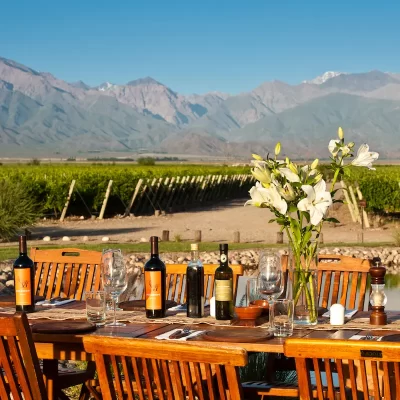
Days are long, dry, and hot, but evenings are perfect for open-air dinners and tastings at winery patios. It’s peak season, so booking accommodations and tours in advance is key.
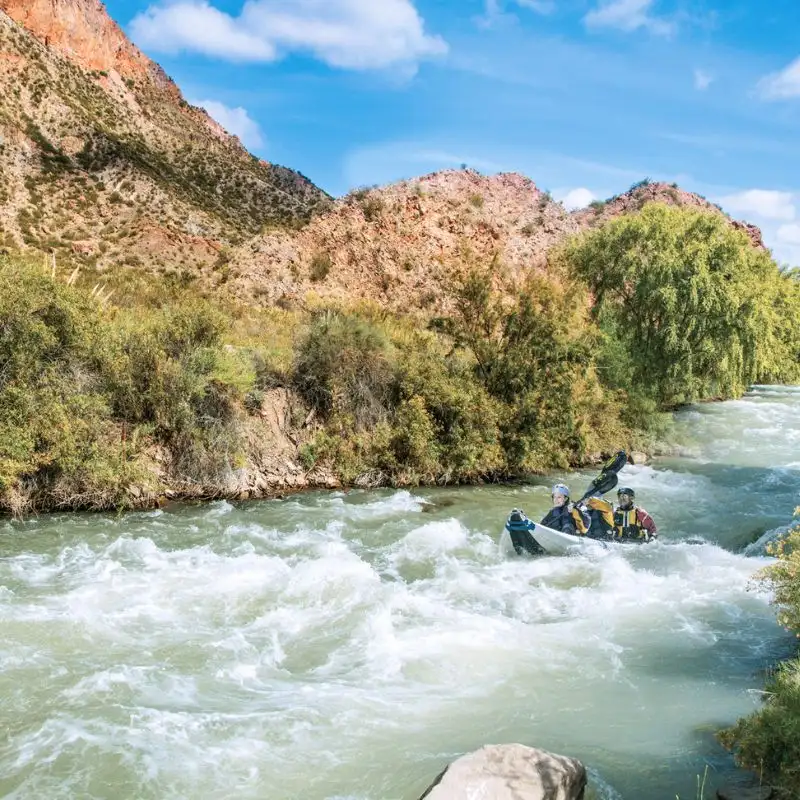
In the city, the heat can be strong, but the countryside and mountains offer refreshing escapes. Options include a Half Day Wine Tour in the morning, rafting the Mendoza River, or spending the day at a mountain estancia with barbecue and horseback riding.
What to bring: sunscreen, water bottles, comfortable shoes, a hat or cap, and breathable clothing.
Mendoza in Autumn: Harvest, Gastronomy, and Golden Scenery
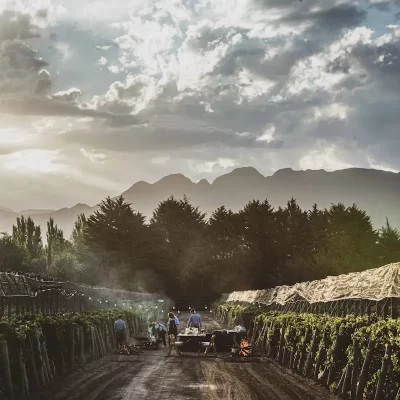
Harvest season sets the rhythm of autumn. Starting in March, vineyards begin to pick grapes and everything smells like fresh wine. Leaves turn golden-red and the afternoons are perfect for sipping a glass of Malbec overlooking the rows of vines.
It’s the best season for food and wine lovers. Wineries are active, kitchens use fresh seasonal ingredients, and the weather is ideal for relaxed touring. Try a classic wine tour, a food and wine pairing experience, or even participate in a harvest. Many wineries also host their own seasonal events at Mendoza wineries during this time, from live music to open-air tastings.
In the mountains, landscapes are stunning. If you visit in May, you might catch the first snowfalls from Uspallata or Potrerillos. This is also the season when the Zonda wind tends to blow strongest.
Mendoza in Winter: Silent Whites, Bold Wines, and Mystical Peaks
July brings a slower rhythm. Temperatures drop and snow covers the Andes. The air is crisp and dry—ideal for peaceful hikes, bonfires, and hearty regional cuisine.
Wineries are quieter. You can enjoy longer tastings and guided tours with fewer people. In the mountains, excursions are more contemplative. Entering Aconcagua’s base camps isn’t possible in winter due to snow, ice, and avalanche risks. However, you can still visit the park’s scenic viewpoint or stop at Puente del Inca or Uspallata, depending on weather and road conditions.
What to pack: technical clothing, waterproof jacket, gloves, lip balm, and UV-filter sunglasses.
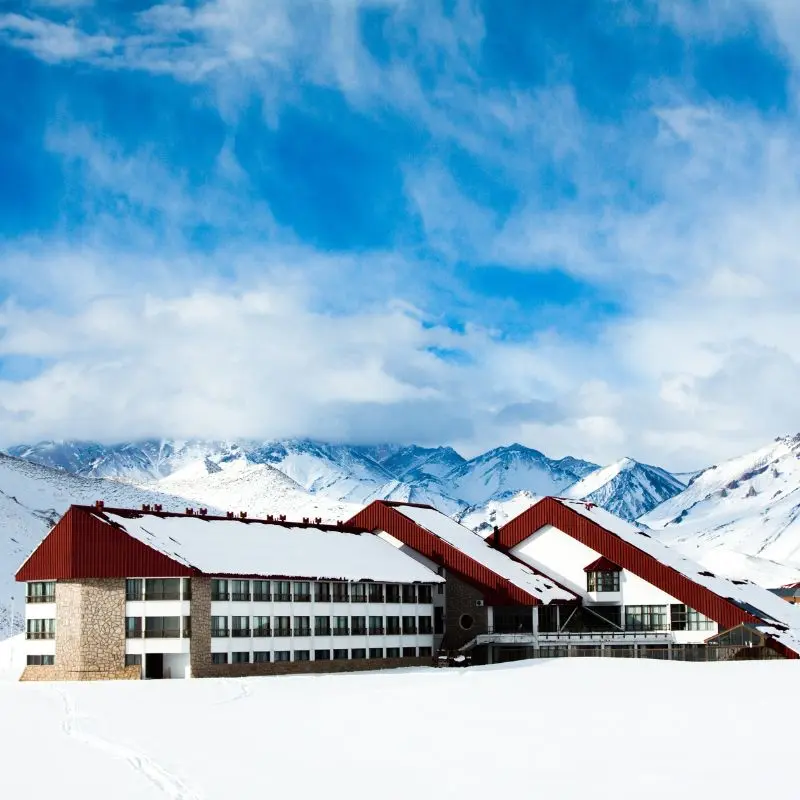
National Harvest Festival: A Must-See Celebration
If your trip coincides with early March, you’ll witness one of Argentina’s most iconic cultural events: the Fiesta Nacional de la Vendimia. This festival celebrates the winemakers, grape harvest, and Mendoza’s wine identity.
Events span several weeks, including the Blessing of the Fruit, the White Parade, and the Carrusel. The main event takes place at the Frank Romero Day Greek Theater, featuring over 1,000 artists, live music, projections, and fireworks.
National Geographic named it the world’s best harvest festival thanks to its scale, artistry, and ability to move even those unfamiliar with wine. It’s a powerful mix of tradition, tech, and creativity.
If you’re traveling between late February and early March, book in advance. Our Grape Harvest Festival experience ensures you don’t miss a moment, Vendimia is not improvised, it’s lived.
The Three Windows That Decide When You Can Travel
Some things in Mendoza are available all year. Three are not, and if one of them is the reason you are coming, it decides your dates for you.
Harvest: late February to early April
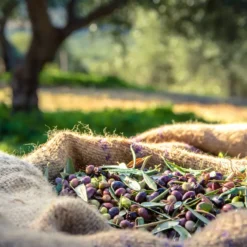
Harvest runs from late February to early April, moving from the warmer, lower vineyards of Maipú and Luján de Cuyo up into the cooler Uco Valley, which finishes last. The Vendimia festival, covered further up this page, falls at the start of March. Both the festival and the wineries that let visitors pick sell out, because places per day are limited — see all grape harvest wine tours.
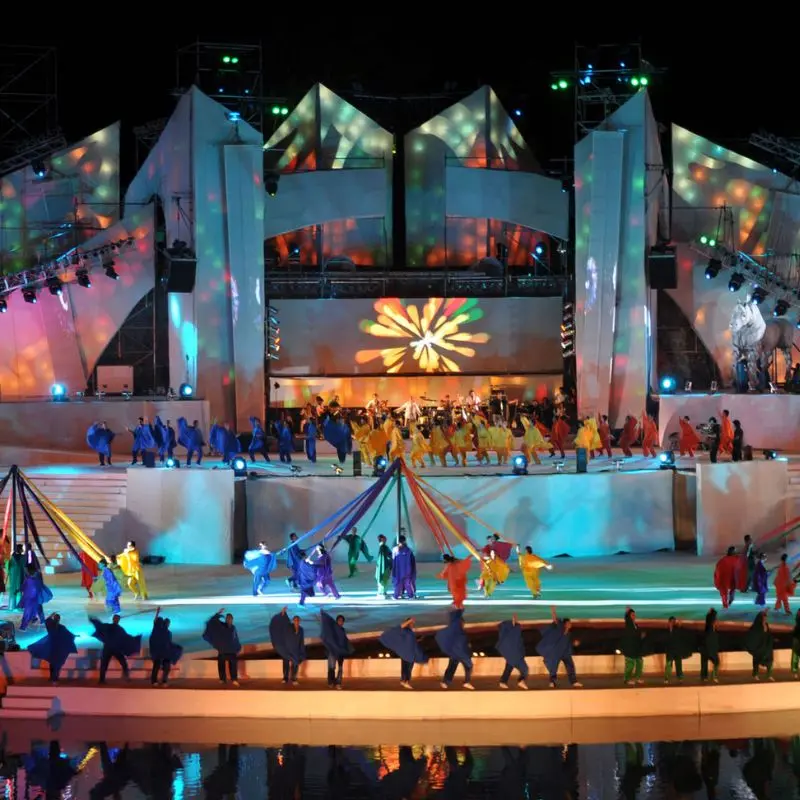
Snow and ski: June to September, peaking in July
Ski season runs from June through September, strongest in July and August at Las Leñas and Los Penitentes. The detail that catches international travellers out is the Argentine school calendar: Mendoza’s 2026 winter break runs from 6 to 17 July, Buenos Aires from 20 to 31 July, and Córdoba from 6 to 17 July. Those are the weeks when the resorts and mountain hotels fill. For snow without the crowds, aim for the second half of August — our winter vacation packages cover both windows.
Climbing Aconcagua: mid-November to late February
The climbing and trekking season in Aconcagua Provincial Park runs from mid-November to late February, and the park stops issuing new permits at the end of February. January gives the most consistent summit weather. Park permits for a summit attempt in high season cost approximately USD 1,000 to USD 1,400 per person, paid directly to the Mendoza provincial government and separate from any expedition fee. Outside that window the base camps are closed and the most you can do is the high Andes day tour to the Aconcagua viewpoint, which runs whenever the international road is open — details on our Aconcagua expeditions page.
That is the short version of the window. Our full guide to when to climb Aconcagua takes the whole year month by month, breaks the park permit out from the expedition price, and answers how much experience the Normal Route really needs.
Weather in Mendoza’s High Mountains by Season
The high-mountain climate in Mendoza changes dramatically. Above 2,500 meters, temperature swings can exceed 20 °C (68°F) in a single day. The sun is intense—even in winter—and conditions can shift fast, so proper gear and current weather checks are essential.
In summer, access roads like Cristo Redentor and Puente del Inca are open. Aconcagua Park allows treks to Confluencia base camp. Autumn offers good visibility but brings early snow and more frequent Zonda winds.
Winter often closes high-altitude routes, including the international pass. Excursions into Aconcagua are not permitted. In spring, melting snow gradually reopens the routes. October can bring muddy paths and gusty winds, but the views are worth it.
Enjoy the best wine tastings in Mendoza

Mendoza Tours
The Zonda Wind: What It Is and How It Impacts Travel
Zonda is a typical dry wind from the Andes. It forms as Pacific air masses cross over and descend on the eastern side, warming and losing moisture as they fall.
It’s most common in autumn and spring, particularly in pre-Andean areas like Uspallata or Cacheuta, but it can also reach the city. Expect a sudden rise in temperature, low humidity, and airborne dust. It may cause headaches or fatigue.
If Zonda is forecasted, avoid mountain roads, postpone hikes, and stay hydrated. Many tours are canceled for safety, so always check conditions the day before.
How Much Does It Cost to Travel to Mendoza by Season?
Prices vary significantly depending on the season. During summer holidays, Holy Week, harvest time, and July (snow season), Mendoza enters its high season, with higher costs for lodging, flights, and activities.
In contrast, May, June, and November are considered low season, with fewer tourists and better deals.
Budget trips start around USD 70 per day. Premium experiences focused on fine wine and gastronomy can exceed USD 250 daily. For a full breakdown by traveler type, see our detailed budget guide for every season.
Season is not the only thing that reshapes a Mendoza trip. Travelling with children changes which days are worth doing at all: our guide to Mendoza with kids, by age sets out what works at 0 to 5, 6 to 12 and 12 to 18, and what to leave for a later trip.
What each season actually costs: real prices from our catalogue
Seasonal guides tend to say “expect to pay more in high season” and leave it there. Here are the actual per-person prices we charge for the experiences that define each season, so you can build a budget instead of a guess. Prices are per person in US dollars, current as of September 2026, and link straight to the tour page where you can see exactly what is included and what is not.
| Experience | Which tour | Price per person | When it runs |
|---|---|---|---|
| Wine tour, 2 wineries with tasting | Private, Luján de Cuyo + South Uco | from USD 77 | All year |
| Wine tour, 3 wineries with lunch | Private, North Uco Valley | from USD 164 | All year |
| Bike wine tour, 2 wineries | Chacras de Coria by bike | from USD 87 | Sept–May (best Oct–Apr) |
| Bike wine tour with lunch, 3 wineries | Chacras de Coria, gourmet lunch | from USD 153 | Sept–May |
| Harvest: pick the grapes yourself | Grape harvest wine tour | from USD 260 | Late Feb–early Apr |
| Harvest festival | National Vendimia experience | from USD 80 | Early March |
| Cooking class at a winery | Zuccardi, Maipú | from USD 136 | All year |
| High Andes & Aconcagua viewpoint | Small group day tour | from USD 118 | All year, road permitting |
| Andes trekking day | Vallecitos, Cordón del Plata | from USD 116 | Oct–Apr |
| Aconcagua Park trek, Confluencia | Confluencia camp | from USD 259 | Mid-Nov–late Feb |
| Aconcagua Park trek, 3 days | Plaza Francia + south wall | from USD 371 | Mid-Nov–late Feb |
| Rafting on the Mendoza River | Half day on the river | from USD 55 | Best Oct–Mar |
| Kayaking | Potrerillos Lake | from USD 55 | Best Oct–Apr |
| Hot air balloon over the vineyards | Sunrise flight | from USD 77 | All year, weather permitting |
| Thermal spa day | Termas de Cacheuta with lunch | from USD 66 | All year — best in winter |
| Mendoza city walking tour | Half day on foot | from USD 32 | All year |
| Multi-day package | Active Week, 6 days | from USD 1,758 | All year |
Read down the right-hand column and the shape of the year becomes clear. A wine-focused trip costs roughly the same in any month, so you may as well come when the wineries are working — March or April. An adventure trip only works between October and April. A snow trip is June to September and nothing else. If your dates are fixed and your interests are not, the table tells you what to do with the week you have; if it is the other way round, tell us what you want to do and we will tell you when to come.
Every season has
its own Uco Valley
Find the right activities for whenever you’re planning to go
Discover things to do!
THINGS TO DO IN THE UCO VALLEYHow to Get to Mendoza Year-Round
Check out our complete guide to reaching Mendoza. Flights connect Mendoza with Buenos Aires, Córdoba, Rosario, Salta, Santiago de Chile, and Lima.
Buses offer daily service from nearly all major cities and international routes from Chile. Driving in gives you more freedom—especially for exploring Valle de Uco or the mountains. The Paso Los Libertadores crossing from Santiago is spectacular but may close in winter.
Currently, there are no passenger trains from Buenos Aires. However, local trains run within Greater Mendoza.
Frequently Asked Questions
What is the best month to visit Mendoza?
March, if you came for wine: harvest is under way, the weather is mild and the vineyards are at their most alive. April is close behind and noticeably quieter. If you came for the mountains, January. If you came for snow, July.
How many days should you spend in Mendoza?
Three full days is the realistic minimum: one for Luján de Cuyo or Maipú, one for the Uco Valley, and one for the high Andes. Five days lets you add harvest, rafting or a spa day without rushing, and a week covers Mendoza plus San Rafael or Las Leñas. We break this down in 3, 5 and 7 days compared, with what each length costs.
What is the cheapest time to visit Mendoza?
May, June and the first half of September. The vineyards are dormant rather than dramatic, but tastings are longer and less crowded, flights and hotels drop, and the tour prices in the table above do not change with the season.
When is harvest season in Mendoza?
Late February to early April. It starts in the warmer, lower vineyards of Maipú and Luján de Cuyo and finishes in the cooler Uco Valley. The National Harvest Festival, the Vendimia, is held in early March.
Is Mendoza worth visiting in winter?
Yes, and for two different reasons. The Andes get real snow between June and September, with skiing at Las Leñas and Los Penitentes. And the wineries are at their quietest, which means longer tastings, more time with the winemaker and no queue at the good tables.
Can you climb Aconcagua all year?
No. The park’s climbing and trekking season runs from mid-November to late February, and no new permits are issued after February. Outside that window you can still reach the Aconcagua viewpoint on a day tour whenever the international road is open.
Is Mendoza, Argentina worth the trip?
If you have any interest in wine, mountains or both, yes. Mendoza is Argentina’s wine capital and the gateway to the highest peak outside Asia, and the two are ninety minutes apart. It is one of the few places where a vineyard lunch and a 4,000-metre viewpoint fit into the same day.

Paula is a travel communications specialist with solid expertise in wine tourism and adventure travel in her native Mendoza. She combines a background in audience analysis with a deep understanding of today’s travelers to craft effective, user-centered, and sustainable content strategies. Her approach blends creativity, data, and a strong commitment to the responsible development of tourism in Argentina.
Pingback: Weather in the High Mountains of Mendoza: Guide & Tips
Pingback: How Much Does a Trip to Mendoza Cost? Budget Guide
Pingback: How Many Days in Mendoza? 3, 5 and 7 Days Compared
Pingback: Things to Do in Mendoza: 20 Plans Sorted by Zone (2026)
Pingback: How to Travel to Mendoza: Guide by Departure Point